Boat Registration & Titling — Without the Runaround
State agencies write for bureaucrats. We write for boat owners. Find exactly what you need to register, title, or transfer your vessel — in plain English.
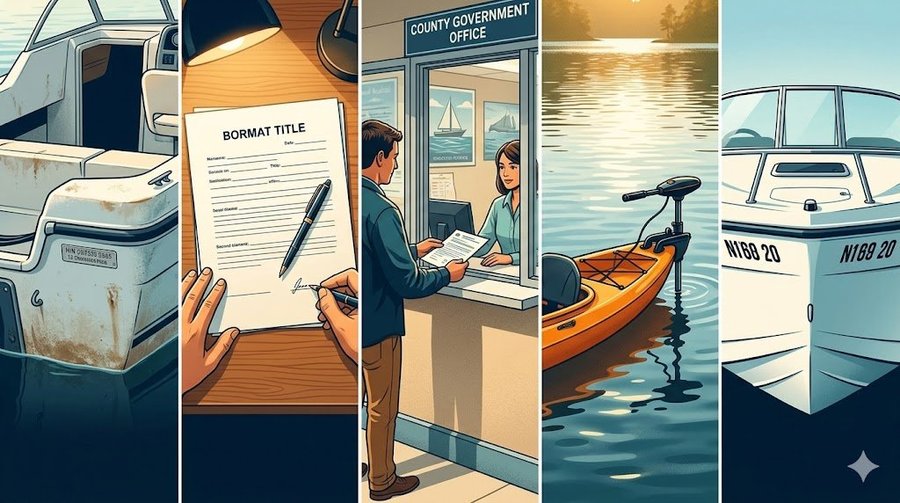
What Do You Need to Do?
Start here — we'll point you to exactly the right guide for your situation.
I Just Bought a Boat from a Private Seller
You have a bill of sale and maybe a title. Here's every step to get it registered in your name, what to do if the title has a lien, and how long it takes.
Read the guide →I Have No Title for My Boat
Old boat, missing paperwork, inherited vessel — you're not stuck. Most states have a clear path. We explain bonded titles, bill of sale registration, and abandoned vessel processes by state.
Read the guide →Does My Kayak / Canoe Need to Be Registered?
It depends on your state and whether it has a motor. We break it down for every state — including the exact threshold where registration kicks in.
Read the guide →My Registration Lapsed — What Are the Penalties?
Late fees vary by state from $5 to $100+. Some states have grace periods; others don't. Find your state's rules and the fastest way to get legal again.
Read the guide →I'm Registering a Boat from Another State
You typically have 60–90 days after establishing residency before you must re-register. We explain what documents transfer, what you'll need to replace, and typical timelines.
Read the guide →I Just Bought My First Boat — Where Do I Start?
A complete first-timer's walkthrough: registration vs. titling, what documents you need, how to display your numbers, and what not to forget before you launch.
Read the guide →Free Tool
Boat Registration Checklist Generator
Select your state, vessel type, and situation — get a complete, printable checklist of every document you need, estimated fees, and processing times. No email required.
Generate My Checklist →Quick Lookup
Browse by State
In-depth registration and titling guides for the top boating states — fees, forms, timelines, and state-agency contacts.
Browse by Vessel Type
Registration rules vary significantly by vessel type — especially for non-motorized boats and personal watercraft.
🚤 Powerboats & Motorboats
All motorized vessels require registration in every state. We cover titling, hull ID requirements, and number display rules.
Powerboat guide →🛥️ Pontoon Boats
Pontoons are treated as motorized vessels in all states. Special rules apply for liveaboard pontoons and those without titles.
Pontoon guide →🏄 Jet Skis / Personal Watercraft
PWC are legally classified as vessels in all 50 states. Titling rules, operator age requirements, and safety cert requirements covered.
Jet ski guide →🛶 Kayaks & Canoes
Non-motorized kayaks don't need registration in most — but not all — states. We break it down completely.
Kayak guide →⛵ Sailboats
Sailboats with motors follow standard registration rules. Sail-only vessels have their own set of state-by-state exemptions.
Sailboat guide →🎣 Jon Boats
Among the most-searched vessel types — often bought used with minimal paperwork. Covers titled vs. non-titled states.
Jon boat guide →Free Download: Used Boat Buyer's Paperwork Checklist
What to verify before you sign, red flags that signal a title problem, and exactly what documents to collect from any private seller. One page, printable.
Common Questions
In most states, if a vessel is used exclusively on private waters (a private pond entirely on your property), registration is not required. The moment it touches public navigable waters — including public boat ramps or connecting waterways — registration is mandatory. Texas, Florida, and Michigan all follow this rule. Verify with your specific state agency before assuming an exemption applies.
It depends heavily on your state and how you submit. Walk-in at a county tax collector (Florida) or DNR office typically takes same-day to 2 weeks. Mail-in applications take 3–6 weeks in most states. Michigan DNR processes mail-in title transfers in 4–8 weeks; Ohio BMV is typically 3–4 weeks. California DMV runs 6–10 weeks for mail-in vessel registration. Expedited options are available in some states for an extra $15–$30.
It depends on the state and the age of the vessel. In states like Tennessee and Alabama, older vessels (typically pre-1973, before federal titling requirements) can often be registered with just a notarized bill of sale. In Florida and Texas, a title is required for vessels over a certain length (14 ft in FL; 14 ft in TX). If no title exists, most states have a bonded title or "title by surety bond" process. See our no-title guide for state-by-state details.
The Hull Identification Number (HIN) is a 12-character alphanumeric code assigned to every boat manufactured after November 1, 1972 — similar to a VIN on a car. You'll find it on a plate or stamped directly into the transom (rear) of the boat, on the starboard (right) side. If a boat lacks a HIN (pre-1972 or homemade), your state agency can assign one during registration. Never buy a boat where the HIN has been removed or appears altered — this is a major red flag for a stolen vessel.
Penalties vary by state but are consistently significant. In Florida, operating an unregistered vessel is a second-degree misdemeanor — up to 60 days in jail and a $500 fine. In Texas it's a Class C misdemeanor with fines up to $500. Michigan issues fines of $100–$500. Most states give officers discretion to issue a warning for first-time offenders with an expired (not missing) registration, but this is not guaranteed. Operating with no registration at all is treated more seriously than a lapsed registration in virtually every state.